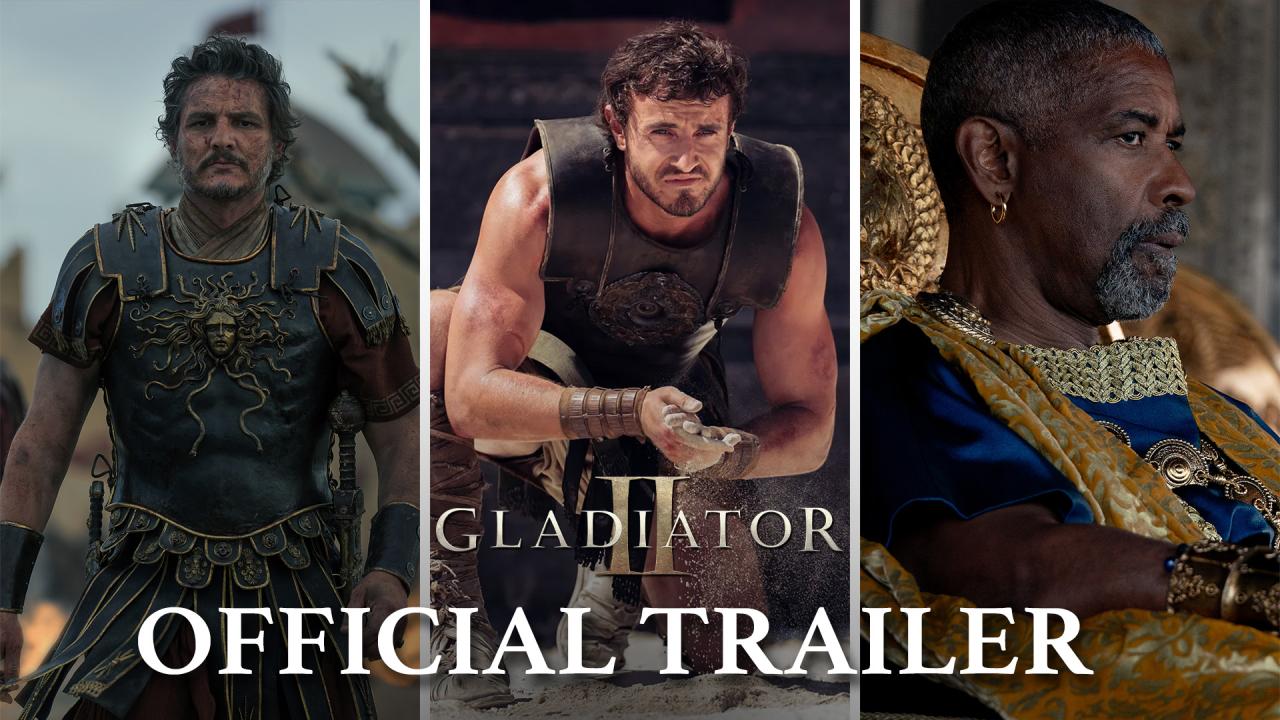
What is most intriguing about Gladiator 2 is not just its unexpected arrival 24 years after the original film, which is regarded as a cinematic landmark, but also because Ridley Scott, at the age of 86, has produced a sequel that feels remarkably contemporary and in tune with current times, almost as if it were directed by a young filmmaker in their thirties. This is what I appreciate about Ridley Scott: his evolving cinema over the past two decades. He has been involved in numerous masterpieces as well as more controversial films, leading some to suggest he is dismantling his own body of work. However, Ridley Scott understands that time is limited and wants to create the kind of cinema he enjoys, which sometimes alienates certain audiences. With Gladiator 2, he presents a sequel primarily for its spectacle. In Roman times, people would gather to watch gladiators fight purely for entertainment, and this is exactly what Ridley Scott offers today with his Gladiator 2 – an action-packed film that delivers the show expected from him. It features action, violence, brutality, masculinity, eccentricity, but most importantly, grand spectacle with a flair reminiscent of ’90s films where one could relax and not take things too seriously.
Respect & Robustness
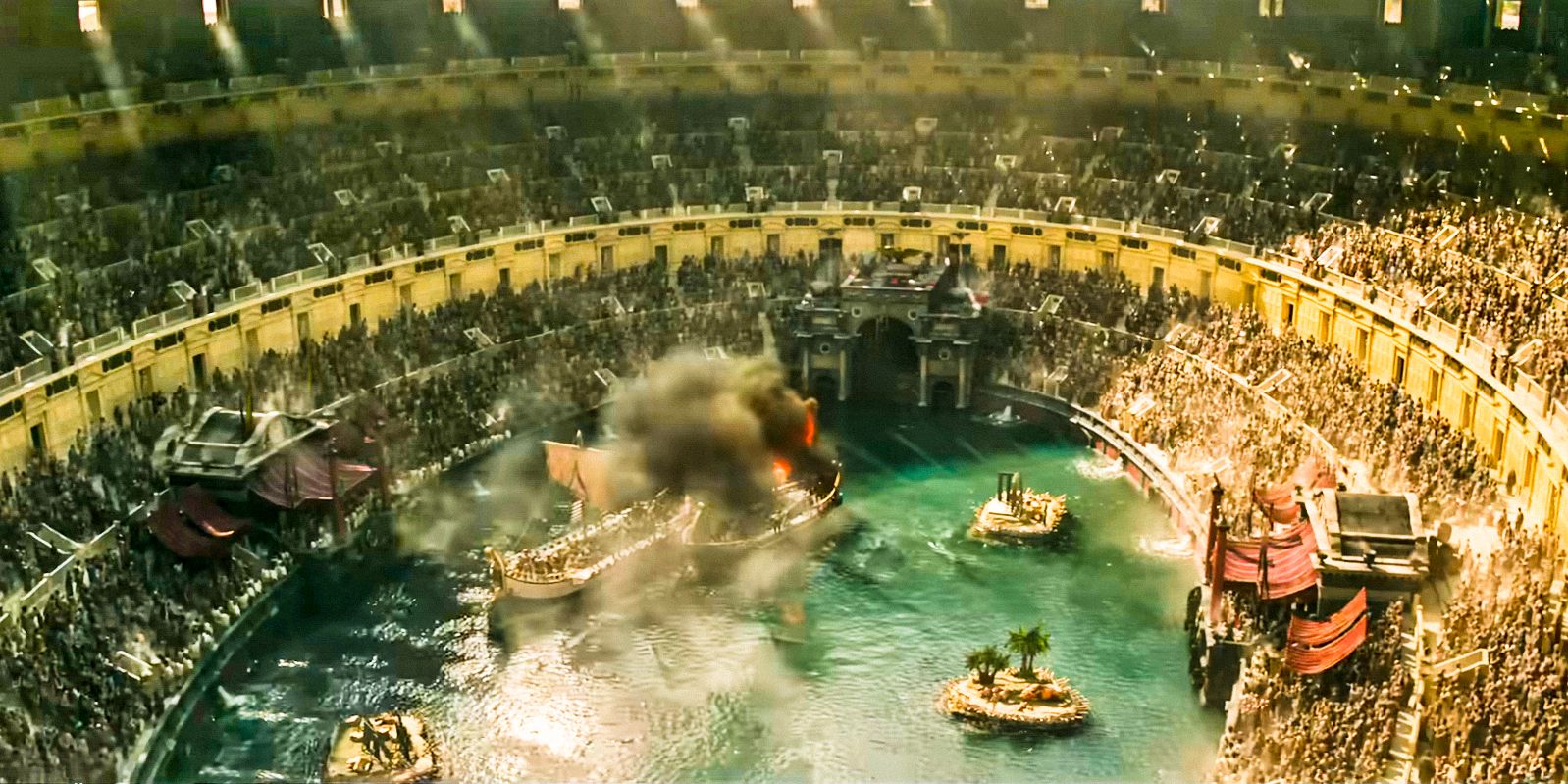
The same applies to the sets: nothing was left to chance, and notably, Ridley Scott insisted that a real-life Colosseum be constructed for the production. This is another testament to the audacity of the project. Building a genuine Colosseum was not merely a whim of a grand filmmaker; it also served the film well by aiming to recover ancient methods, an old-school approach, and the practical side, which Hollywood has increasingly turned into a marketing specialty in recent years. Let me clarify that I am not suggesting there are no digital effects in the movie—there are indeed many—but there is a Top Gun: Maverick vibe in wanting to create and rediscover a cinema style that somewhat got lost over the past 15 years.
As previously mentioned, Gladiator 2 draws upon elements from its predecessor, which is evident in both the narrative and casting choices. The focus here is on Lucius, identified as the son of Maximus Decimus, the character portrayed by Russell Crowe in the original film. In the first installment, the story revolved around a former Roman general who became a gladiator to reclaim his honor and freedom after seeking vengeance. While the narrative structure of Gladiator 2 shares some similarities with its predecessor, it also takes into account the passage of several decades—approximately twenty years—and the ongoing evolution of the Roman Empire, which continued to progress but more so deteriorate. Ridley Scott clearly draws a parallel between the decline of the Roman Empire and that of contemporary nations such as the United States, extending this analogy to Western civilization at large. This empire, under leadership lacking in experience and morality, must reconnect with its historical roots to restore its former greatness.
In all cases, this Gladiator 2 may have lost the emotional depth that characterized the first film, but it has gained in plot complexity, featuring a more refined political discourse that enhances the narrative. Through the character of Denzel Washington, the story becomes, if not even more compelling than its predecessor. Denzel Washington delivers an unsettling and demonic performance, confirming his tendency to occasionally deviate from traditional acting norms. There is a sense that he steps straight out of “Training Day” into Roman times, which occasionally disrupts the historical setting. At times, it feels as though his acting does not fully align with the period of the Roman Empire. This is not entirely negative, given Denzel Washington’s talent, but there are moments when one senses a disconnect, akin to him appearing out of place on the streets of Los Angeles before entering the Colosseum in Rome.

5-STAR CASTING
In any case, the casting for this Gladiator 2 is also one of its greatest successes, with actors perfectly chosen in each of their roles. There are no false notes, neither in the main nor supporting roles, consistently referencing back to the first Gladiator, which might inconvenience some viewers. Personally, I see it as an homage, especially considering that this sequel arrives 24 years after the original, and let me note that there are generations of young people who have not discovered the original Gladiator, let alone in a cinema setting. Yes, Gladiator 2 is a cinema film, to be seen in the largest halls for the experience to be complete. But let’s return to the casting if you will, because I must commend Paul Mescal. An actor previously unknown to me, having watched none of his films or series, but goodness, what charisma he has; what an actor. He is the worthy successor to Russell Crowe, not as an actor, but as a character destined to succeed Maximus. A challenging role, but he executes it brilliantly, both physically, with a massive build that is not overly muscular, in contrast to Brad Pitt’s Achilles from the original, where the emphasis was more on fashion modeling than ancient Greek combat. Here, Paul Mescal has added muscle, yet most importantly, raw power, much like Russell Crowe did back then. And by the way, I find that Paul Mescal also possesses the same voice, tone, and above all, the conviction to carry a message and inspire men ready to die for him. The scenes where he must rally his troops are so powerful it’s almost overwhelming; I would be ready to die for him too.
To inform you that Paul Mescal is already recognized as a rising star in Hollywood, but I can assure you that following this film, he will see an increase in his contract offers. Specifically, he will take on the role of William Shakespeare in Chloé Zhao’s “Hamnet.” This film does not aim to be a biopic of Shakespeare or a variation of his work; instead, it is set as historical fiction in England during 1580, amidst the Black Plague period. The project appears quite intriguing.
Regarding the casting, it is worth acknowledging the commendable work of Joseph Quinn and Fred Hechinger, who portray the emperors Geta and Caracalla, brothers with clear allusions to Romulus and Remus. While Romulus and Remus are known as the founders of Rome, these brothers are more akin to destructive forces within the empire. Both actors are exceptionally suited to their roles, embodying an eccentric, almost caricatured persona that I found delightful. Although some may disagree, I believe this off-kilter portrayal of these emperors, in line with Lucius’ straightforward character, works well. There is also a sense of breaking away from Commodus, the character played by Joaquin Phoenix in the first film, who was more restrained but clearly harbored rage and jealousy. These emperors, arriving after Commodus, symbolize those buried emotions ready to erupt.
As for Pedro Pascal, he is good but not extraordinary, and I find myself seeing more of him compared to General Acacius. However, it should be noted that the writing for his character is less refined because he does not go to extremes, unlike Lucius or the two emperors. This is due to the nature of his role, and unfortunately, I cannot delve deeper without spoiling the plot. Just as Paramount authorizes reviews publication two days before release, we will avoid revealing too much. Before moving on, I would like to mention Peter Mensah, who is somewhat equivalent to Djimon Hounsou’s character in the first “Gladiator.” I enjoyed his performance in this role, and everyone recognizes him from being swept by Leonidas’ front-kick in “300.” Similarly, a special mention goes to actor Tim McInnerny, who is perfectly cast as the cowardly Thraex, delivering an absolutely delicious portrayal.
Gladiator 2 is a film that will undoubtedly divide its fans, as previously noted. Why? Perhaps due to nostalgia, since it has become entrenched in popular culture and holds an untouchable status as a classic. Many people were not eager for this sequel, and initially, even Ridley Scott was reluctant. He had turned down an early version of Gladiator 2 in 2020, but two years later, circumstances changed to the point where he is now proud of this iteration. This sentiment has been reiterated in interviews, emphasizing that this is Ridley Scott’s film, his vision, and he had final say over it. He insists there will be no other versions after its theatrical release, unlike with some of his other films such as Napoleon, which saw the addition of an extra hour despite initial releases.
Criticism from fans of the first “Gladiator” will focus on the fact that this sequel lacks emotional depth. While you won’t need tissues during the film, there is joy to be found in the brutality of the fights. Not only are there more fight scenes than in the original “Gladiator,” but they are all executed successfully, particularly those involving animals. Initially reluctant upon seeing the trailers, I must admit that these sequences offer an animalistic pleasure that feels not long enough. The battle with the monkeys is especially incredible; it evokes rage and ferocity that tap into our most primitive instincts. What fun!
The user’s input appears to be a detailed review or critique of the movie “Gladiator 2.” They discuss various aspects such as acting, character portrayals, and the intensity of action sequences. Here’s a summary:”Gladiator 2,” directed by Ridley Scott at age 86, surprises audiences with its contemporary feel and bold vision, akin to that of a much younger filmmaker. Known for both acclaimed masterpieces and controversial works, Scott aims to create cinema that he personally enjoys, which sometimes alienates segments of his audience. The sequel emphasizes spectacle, offering grand visuals reminiscent of ’90s films but with less seriousness. Notably, a real-life Colosseum was constructed for the production, reflecting Scott’s commitment to authenticity and practical effects, echoing an older style of filmmaking. The story draws parallels between the decline of the Roman Empire and that of modern Western civilization, emphasizing the need for leaders to reconnect with their foundational values. Casting is highlighted as a major strength, with actors perfectly embodying their roles. Paul Mescal, new to many viewers, shines as Lucius, Maximus Decimus’ son, bringing both physical prowess and conviction to the character. Joseph Quinn and Fred Hechinger deliver eccentric yet fitting portrayals of destructive Roman emperors Geta and Caracalla, contrasting with Joaquin Phoenix’s earlier portrayal of Commodus. While some critics argue that emotional depth from the original is missing, the film compensates with more elaborate action sequences, including animal fights that are both brutal and entertaining. Despite potential fan division due to nostalgia for the first film, “Gladiator 2” remains a bold cinematic endeavor from a director unafraid to evolve his style while paying homage to his past successes.
Have any thoughts?
Share your reaction or leave a quick response — we’d love to hear what you think!
-
 0
0
-
0
-
0
-
0
-
0
-
0


